


-98.jpg)








GigaDevice Powered: The "Core" Behind the Marathon-Winning Humanoid Robot, "Lightning"






Recently, the autonomous navigation humanoid robot "Lightning" (developed by Honor's "Great Sage" team) made global headlines by winning a humanoid robot marathon. Crossing the finish line in an astonishing50 minutes and 26 seconds, "Lightning" not only secured the title but also sprinted past the human world record for the men's half-marathon by nearly seven minutes.
This is more than just a breakthrough in speed. For a robot, long-distance running demands that the control system operates with consistent stability across hundreds of thousands of high-frequency control loops. Any micro-delay or error could be amplified. This achievement is a concentrated manifestation of motion control capability and system reliability, drawing widespread industry attention to the underlying robotics technology.
Behind this "iron physique" lies the chip expertise of GigaDevice. The critical leg joint control units of Honor's "Lightning" robot are equipped with multiple GigaDevice GD32H7 series ultra-high-performance MCUs, providing the extreme computing power, low-latency response, and stability required to support this record-breaking journey.
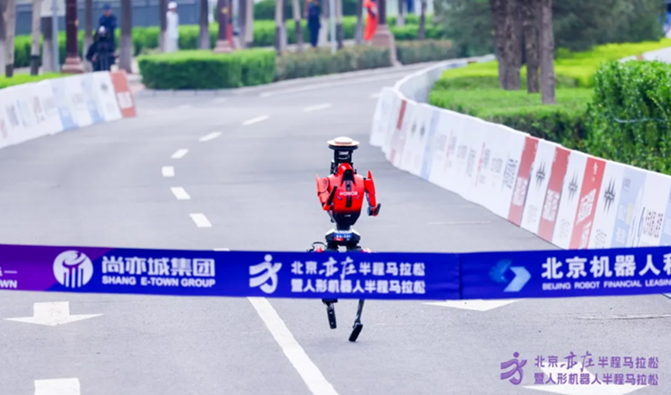
▲Source: Beijing E-Town Half Marathon Official WeChat Account
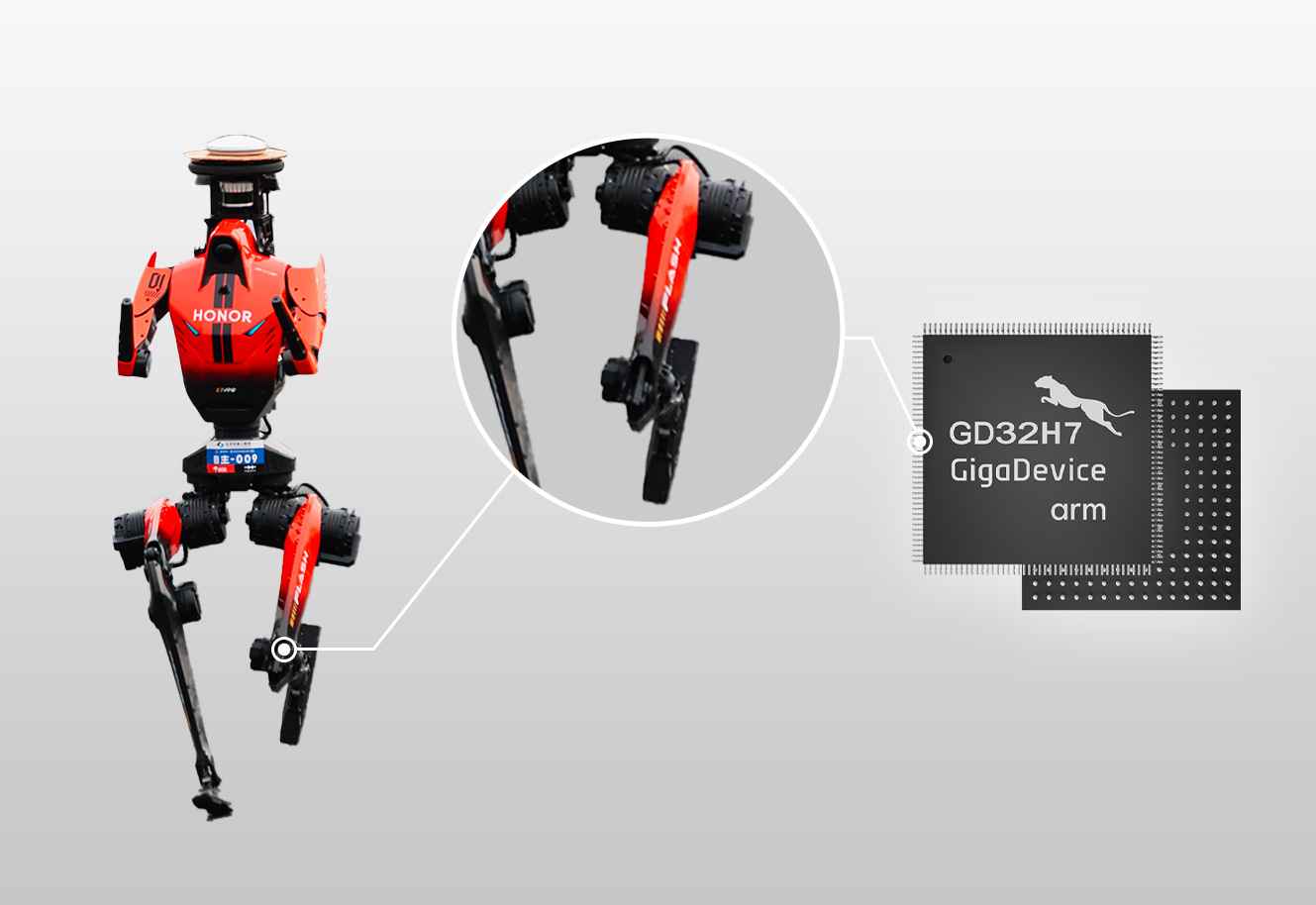
▲Source (Robot Images): Beijing E-Town Half Marathon Official WeChat Account
The "Sprinting" Secret: Why Leg Joints are the Lifeline
In long-distance running, humans rely on the power of robust leg muscles and joints. However, for a humanoid robot, every impact upon landing, every undulation of the terrain, and every real-time adjustment for dynamic balance serves as a rigorous test of leg joint hardware performance. What supports the stable operation of its legs is not merely mechanical structures or algorithmic models, but the control systems hidden within every critical joint.
From an engineering perspective, robot running is not a simple continuous motion but a complex system executed by a vast number of independent control units. Humanoid robot leg joints typically possess around six degrees of freedom (DoF), and each of these is a joint control system requiring real-time response. The so-called "running" is not the movement of the entire machine as a single unit, but rather the result of these joints continuously collaborating and correcting themselves with millisecond precision.
In other words, the essence of robot motion control is not just "making it move," but ensuring that every joint moves in coordination at the right time and in the right manner. Throughout this process—whether it is sensor signal acquisition, control algorithm execution, or driver output—the MCU serves as the core node connecting the robot's perception and execution. For joint control, an MCU must simultaneously satisfy four key capabilities:
1. Exceptional Speed: Guaranteeing Real-Time Execution of Control Loops
Running is an inherently highly dynamic process. The moment the sole impacts the ground, the ground reaction force (GRF) undergoes rapid shifts. The MCU must complete a full closed-loop cycle—encompassing "Sensor Acquisition → Filtering Algorithms → Control Calculation (e.g., FOC Current Loops) → PWM Output"—within an extremely narrow window.
If the MCU's clock speed is insufficient or the interrupt response mechanism is sluggish, the control signals will suffer from small latencies. This millisecond-level delay cause the robot's corrective actions to lag behind the actual physical forces. When facing sudden disturbances, such as potholes or uneven terrain, this "compensation lag" makes the robot highly susceptible to falling.
The GigaDevice GD32H7 series provides a performance foundation specifically optimized for high-dynamic control:
Massive Throughput: Powered by a 600MHz Cortex®-M7 core, it delivers formidable processing power to drastically shorten control calculation cycles.
Integrated Hardware Acceleration: Trigonometric Math Units (TMU) and Floating Point Units (FPU) significantly boost the execution efficiency of FOC, filtering, and other complex algorithms.
Ultra-Low Latency: Tightly Coupled Memory (TCM) and high-speed interrupt architecture achieve near-instantaneous response, effectively eliminating control lag.
Gait Precision: High-speed ADCs work in tandem with advanced timers to precisely match the requirements of dynamic running scenarios, enhancing overall gait stability.
The synergy of these capabilities allows the control system to maintain a stable execution rhythm within high-frequency closed loops, enabling immediate compensation during dynamic motion and preventing falls caused by sudden operational shifts.
2. Seamless Multi-Joint Synchronization
If "responsiveness" ensures that a single joint can keep pace with control commands, then "stability" is what defines the seamless orchestration of the entire multi-joint system.
Running demands a level of kinematic complexity far beyond that of a standard walking gait. With six or more Degrees of Freedom (DoF) per leg, the MCU must solve intensive inverse kinematics and model-based control algorithms in real-time, while simultaneously managing high-speed data to adjust motor angles on the fly.
Any desynchronization between the MCUs managing the torso, hips, knees, and ankles can lead to critical coordination failures—such as a leading foot striking the ground before the trailing leg has even begun its recovery cycle. Ultimately, the integration of industrial-grade communication buses is the cornerstone of this synchronization precision, ensuring the robot moves as a unified entity rather than a collection of independent parts.
The GigaDevice GD32H7 series ensures this systemic harmony through several architectural advantages:
Hardware-Accelerated Computing: The integration of a dedicated hardware Trigonometric Math Unit (TMU) and a Filter Acceleration Cluster (FAC) significantly accelerate processing speeds.
Low-Latency Interconnects: Integrated CAN FD and EtherCAT® (with 2*PHY) support ensure ultra-low latency communication between joints, meeting the stringent real-time requirements of high-dynamic running gaits.
The performance of the GD32H7 allows the control system to maintain a rhythmic execution pace even in the most compute-intensive scenarios, enabling "Lightning" to adjust its posture instantly to maintain stability.
3. Industrial-Grade Robustness: Precision Control Under Extreme Conditions
Winning a humanoid marathon requires the MCU to maintain "fine-tuned" control over joint motors even under the most punishing real-world conditions. This mission-critical reliability is demonstrated in two key dimensions:
High-Fidelity Sensing: The violent current fluctuations inherent in high-speed running demand that the MCU's built-in ADC to deliver superior sampling rates and precision. Without this, the system cannot accurately track the motor rotor's position or current magnitude in real-time.
Mission-Critical Reliability: Joint motors endure nearly an hour of continuous high-power operation, causing internal cavity temperatures to soar above 100°C. To ensure precise current sampling, motor control, and data exchange under such thermal stress, the MCU must meet strigent industrial-grade reliability standards.
To address these engineering challenges, the GD32H7 series provides a comprehensive foundation for both perception and reliability:
Advanced Perception Engine: Features dual 14-bit ADCs with sampling rates up to 4MSPS and a 12-bit ADC reaching 5.3MSPS. It supports multi-channel synchronous sampling and hardware oversampling to ensure high data accuracy.
Uncompromising Thermal Resilience: Engineered to industrial standards, the GD32H7 maintains its full 600MHz clock speed even at an ambient temperature of 105°C, ensuring zero performance throttling when conditions become extreme.
In a marathon, any single point of failure results in immediate exit. The ability to deliver sustained, high-quality, and stable performance is "Lightning's" ultimate secret to victory. The industrial-grade reliability of the GD32H7 is purpose-built to meet these exact demands.
4. Superior Efficiency: Maximizing Endurance and Thermal Stability
For a high-speed marathon spanning nearly an hour, energy efficiency is as critical as raw performance. Excessive power consumption not only drains the battery but also generates excess heat, creating a "thermal footprint" that compromises system stability and forces frequent, inefficient battery swaps. Consequently, an MCU must strike a careful balance between peak performance and power conservation.
The GD32H7 series redefines power management through a highly versatile architecture:
Dynamic Power Scaling: Supports three distinct power supply modes (LDO, SMPS, and Direct Power) alongside five low-power modes, allowing for precise energy optimization tailored to the robot's operational state.
Industry-Leading Efficiency: The GD32H7 can maintain a stable 600MHz clock speed at a core voltage of just 0.9V. Compared to industry alternatives that typically require 1.25V or higher (often through overclocking), the GD32H7 reduces power consumption by more than 50% under equivalent workloads.
By integrating these advanced power-saving features, the GD32H7 ensures lower heat dissipation, improved system reliability, and significantly extended battery life for the robot's demanding operation.
Beyond Joints: GigaDevice's Full-Stack Robotics Chipset Portfolio
The rise of humanoid robotics marks the dawn of the Embodied AI era. As a leading semiconductor supplier, GigaDevice has engineered a diversified "Control + Memory + Analog" product portfolio, providing comprehensive hardware support for the next generation of intelligent machines:
1. MCU
Centered around the GD32H7 and GD32F50x series MCUs, GigaDevice's portfolio addresses the entire spectrum of humanoid movement—from the fine motor control of dexterous hands and robotic arms to the high-torque demands of torso and leg joint actuation.
2. Memory
GigaDevice offers a versatile range of storage solutions, including SPI NOR Flash, SPI NAND Flash, and DRAM. These high-throughput solutions satisfy the requirements for instantaneous boot-up and real-time response, providing the high-speed, mission-critical storage backbone for the "AI Brain" that drives complex decision-making.
3. Analog
Led by the GD30DC1901/GD30DC1902 series high-efficiency power management ICs and the GD30BM2016 series high-precision battery management AFEs, GigaDevice enables superior energy conversion and maximizes battery utilization.
The GD30DRE518/GD30DR1488/GD30DR1401 series motor drive SoCs (based on the Cortex®-M33 core with CAN FD support) are engineered to ensure rapid motor response and robust operational reliability.
From the marathon track to the future of industrial automation, GigaDevice's semiconductor solutions are the driving force behind the evolution of robotics. We are committed to lowering development barriers and empowering the future of Embodied AI—one high-performance chip at a time.


