


-98.jpg)








What Makes Humanoid Robots Truly Responsive?






Article: Humanoid Robots Need a Real-Time, Distributed Nervous System
Source: embedded.com
Writer: Kevin Jones, Senior Technical Marketing Manager at GigaDevice Semiconductor
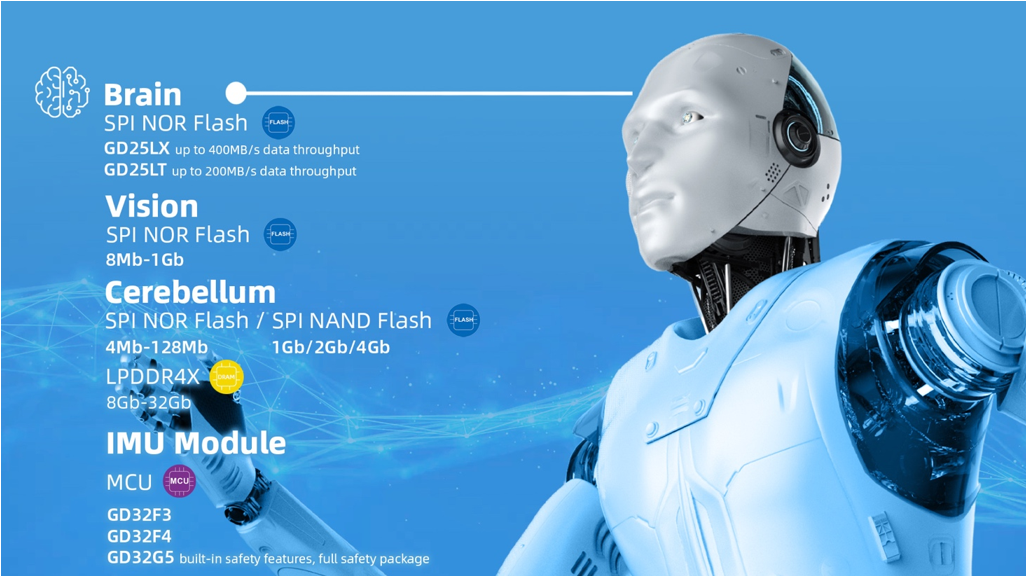
This technical article explores what makes humanoid robots truly responsive. It's not just about embedded AI models, but also the electronic 'nervous system' connecting the robot's 'brain' to every joint and actuator. Emulating human-like motion in humanoid robots is a major engineering challenge that requires a distributed real-time sensing, networking, and control architecture to coordinate many complex movements, rather than a single top-down controller.
In industrial robotics, traditional motion control provides efficiency – but is rigid and struggles to adapt to a changing environment if something unexpected, like an obstruction, occurs. But modern humanoid robots are expected to operate in unpredictable environments, demanding greater situational awareness and the ability to react intelligently to changes.
The article draws an analogy to how the human brain works: the cerebrum makes high-level decisions, while the cerebellum fine-tunes voluntary movements, coordinates muscle timing, and manages posture and balance through a feedforward, error-correcting mechanism that compares intended commands with real sensory feedback.
Modern humanoid robots employ a similar tiered structure. A 'brain' — usually a large vision-language multimodal foundation model — handles high-level scene understanding and planning, but it's too slow (due to token-generation latency) for real-time motor control. So, a separate 'cerebellum' module handles the actual moment-to-moment motor coordination, needing sub-10ms pose estimation and microsecond-level sensor responsiveness. Below the cerebellum, distributed local controllers close to each joint independently run real-time motor-control loops in parallel with trajectory prediction and coordination, handling tactile sensor feedback and failsafe routines, and reporting back up the chain.
Networking is also critical and the 'nervous system' connecting this architecture must be deterministic and very low jitter. EtherCAT® is the best-suited standard, since its telegram-based protocol avoids per-node processing delays and its distributed clock allows sub-microsecond synchronization.
GigaDevice chips, such as the GD32H75E MCU (combining an Arm® Cortex®-M7 with an EtherCAT sub-device controller, alongside CAN-FD bus controllers and high-speed UARTs) and GD30DRE518 motor-drive SoC, are highlighted as examples of components suited to this architecture. Securely integrating hardware-level fault detection, redundancy, and real-time monitoring, providing instantaneous responses to unexpected events, these solutions can support the distributed nature of humanoid robots with real-time networking and control functions, from the machine's brain to the tips of its fingers.
Read the full article on embedded.com at: https://www.embedded.com/humanoid-robots-need-a-real-time-distributed-nervous-system


